
You made the decision. You did the research. You flew to Seoul, went through the consultation, signed the paperwork, and woke up on the other side of surgery.
And now you're lying in your recovery room, scrolling through your pre-op photos, thinking: did I just ruin my face?
You're not alone. And you're not being dramatic.
What Post-Op Depression After Plastic Surgery Actually Feels Like
There's a phase that almost every surgical patient goes through — usually in the first few days to weeks after their procedure — that nobody puts in the brochure.
Your brain starts comparing the past and the present on a loop. Your pre-op face starts to look better in memory than it actually was. Your current face looks worse in the mirror than it actually is. And somewhere in the gap between the two, regret and anxiety start to grow. Was this worth it? Was this the right clinic? Did I even need to do this?
The spiral is real — and it hits hardest when your body is exhausted and your face is at peak swelling.
Why Post-Op Blues Happen: The Science Behind It
There are real physiological reasons why emotional changes occur after surgery.
General anesthesia and the surgical process itself affect the balance of neurotransmitters in the brain — including serotonin and dopamine. This combines with post-surgical pain, disrupted sleep, and a spike in stress hormones like cortisol, all of which contribute to low mood. Research also links the body's inflammatory response during recovery to changes in emotional state.
Post-operative depression and anxiety are well-documented across all types of surgery, not just cosmetic procedures — and tend to be more pronounced after procedures involving general anesthesia.
There's also a psychological component. When you've spent months building up anticipation toward a procedure, the sudden release of that tension after surgery can leave a vacuum. The gap between what you expected to feel and what you actually feel is a recognized psychological response — not a sign that something went wrong, and not a reflection of weakness.
The Most Important Thing to Remember
Early recovery is the worst time to evaluate anything.
At day 3, you are not seeing your result. You're seeing swelling, bruising, tension, and inflammation. The face looking back at you in the mirror is not the face you'll have in three months.
Most people who experience post-op blues — and most people do — look back later and can't believe they were so worried.
That doesn't make the feeling less real right now. But it does mean: try not to make any judgments yet.
The Real Korean Plastic Surgery Recovery Timeline
Recovery photos on social media are curated. The actual process is messier and longer than what gets posted.
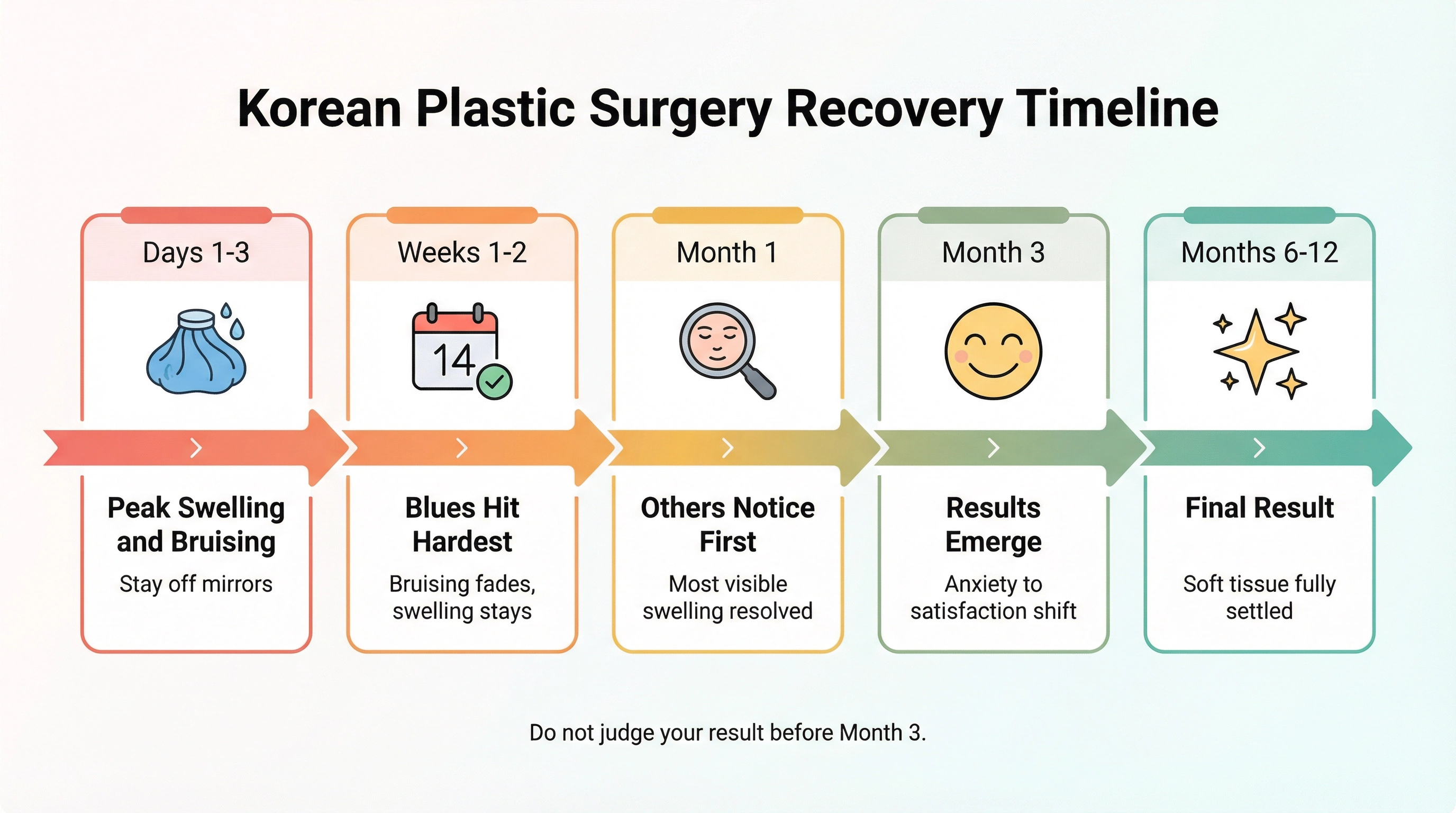
Days 1–3 — Swelling and bruising are at their peak. Your face won't look like your face. Looking in the mirror frequently during this window is genuinely not recommended.
Weeks 1–2 — Visible bruising starts fading but swelling is still significant. This is often when the blues hit hardest — you're expected to function again, but the results still aren't visible.
Month 1 — People around you start noticing a difference before you do. Much of the visible swelling has resolved, but you might still feel uncertain.
Month 3 — This is when results start to become visible. Most people begin shifting from anxiety to satisfaction around this point.
Months 6–12 — For soft tissue procedures — rhinoplasty, fat grafting, contouring — this is when the final result settles. The timeline is longer than most people expect.
Don't compare your real recovery to someone else's highlight reel.
How to Get Through Post-Op Depression
Stop comparing to pre-op photos obsessively. Take one photo per week for documentation, then put the phone down.
Talk to people who've been through it. Online communities around Korean plastic surgery are full of people who've gone through this exact same experience. Reading others' recovery timelines can genuinely help reset your expectations.
Be honest with your clinic. If you have specific concerns about your healing, reach out. That's what post-op appointments are for.
Reserve judgment for month 3. Soft tissue swelling can take 6–12 months to fully resolve. What you see at week 2 is not week 12.
If You're Nervous About Surgery — Try the Reversible Version First
This isn't medical advice. It's a personal perspective from someone who's been through the process.
One of the reasons post-op anxiety hits so hard is the feeling that there's no going back. So if you're on the cautious side, consider this before committing to surgery: start with something you can undo.
Double eyelids — try non-incisional before incisional The buried suture method is reversible — the sutures can be removed and your eyes return to their natural state. It lets you see whether a double eyelid actually suits your face before making a permanent change. If you love it, you can always go incisional later.
Nose — try filler before rhinoplasty If you want a higher bridge, nose filler is worth trying first. Hyaluronic acid fillers can be dissolved with hyaluronidase, which means it's not permanent. Seeing an actual raised bridge on your real face — not a simulation — will tell you more than any consultation. You might love it. Or you might realize it doesn't work with your overall features the way you thought, which saves you from a surgery you'd regret.
Jaw — try Botox before bone contouring If you're considering jaw reduction surgery, masseter Botox is a good first step. It slims the lower face over time and wears off naturally. Bone surgery is irreversible; Botox isn't. Getting a sense of how your face looks with a slimmer jawline first gives you either the confidence to commit — or the clarity to step back.
Volume — try filler before fat grafting Thinking about adding volume to your cheeks or under-eyes? Filler can give you a preview of what that change actually looks like on your face before committing to fat grafting. It also helps you figure out how much is right — volume that looks great in someone else's photos can feel like too much on your own face.
The logic is simple: run a small experiment before making a permanent decision. Surgery isn't going anywhere. Take the detour if you need it.
What to Actually Check in Your Consultation
Before-and-after photos are not enough basis for choosing a clinic. Whether a clinic is right for you often becomes clear during the consultation itself.
Who will actually perform your surgery — the consulting doctor and the operating surgeon are not always the same person. Ask explicitly: "Will you be the one performing my procedure?"
Whether an anesthesiologist will be present — easy to overlook, but for procedures involving general anesthesia, this is a direct safety question.
How to reach the clinic after surgery if something feels wrong — if there's no clear answer to this, that's information worth having before you sign anything.
What the revision policy is — knowing how a clinic handles outcomes that don't meet expectations matters. Ask before you commit.
Why I Wrote This
Post-op blues are normal. But how deep they go often depends on how prepared you were going in.
Try the reversible version first if you're uncertain. Ask the uncomfortable questions in your consultation. Make sure you feel genuinely confident before you commit. Surgery can't be undone — the decision deserves the time you give it.
The blues pass. The swelling goes down. And most people, eventually, love what they see.
But in the meantime — be patient with yourself. You just did something hard.
Navigating Korean plastic surgery from abroad is complicated enough without going through it alone. If you need help researching clinics, knowing what questions to ask, or just figuring out where to start — that's exactly what KBeauty Finder is here for.